

Finding P.I.P.E.R. is a 10-session, 15–20 hour Math Lab where students work as cadets on an interstellar rescue mission — plotting coordinates on oversized planet maps, building a motorized racer, collecting distance and time data, and graphing that data to locate and rescue a stranded robot. Materials include the motorized racer kits, ramp materials for data collection, oversized grid maps, crew badge templates, coordinate plane posters, and data recording sheets.
Students start by working directly on the coordinate plane — plotting points, reading ordered pairs, navigating grid maps. As the mission progresses, they move from plotting to collecting real measurement data, then to graphing that data and using the graphs to make predictions. By the final sessions, they're using rate, ratio, and polygon classification to execute the rescue — applying coordinate geometry and data analysis in the context of a sustained, collaborative project.
How the Curriculum Works
The Lab opens with crew badge design and coordinate plotting, then moves through engineering, data collection, graphing, and a multi-session rescue mission:
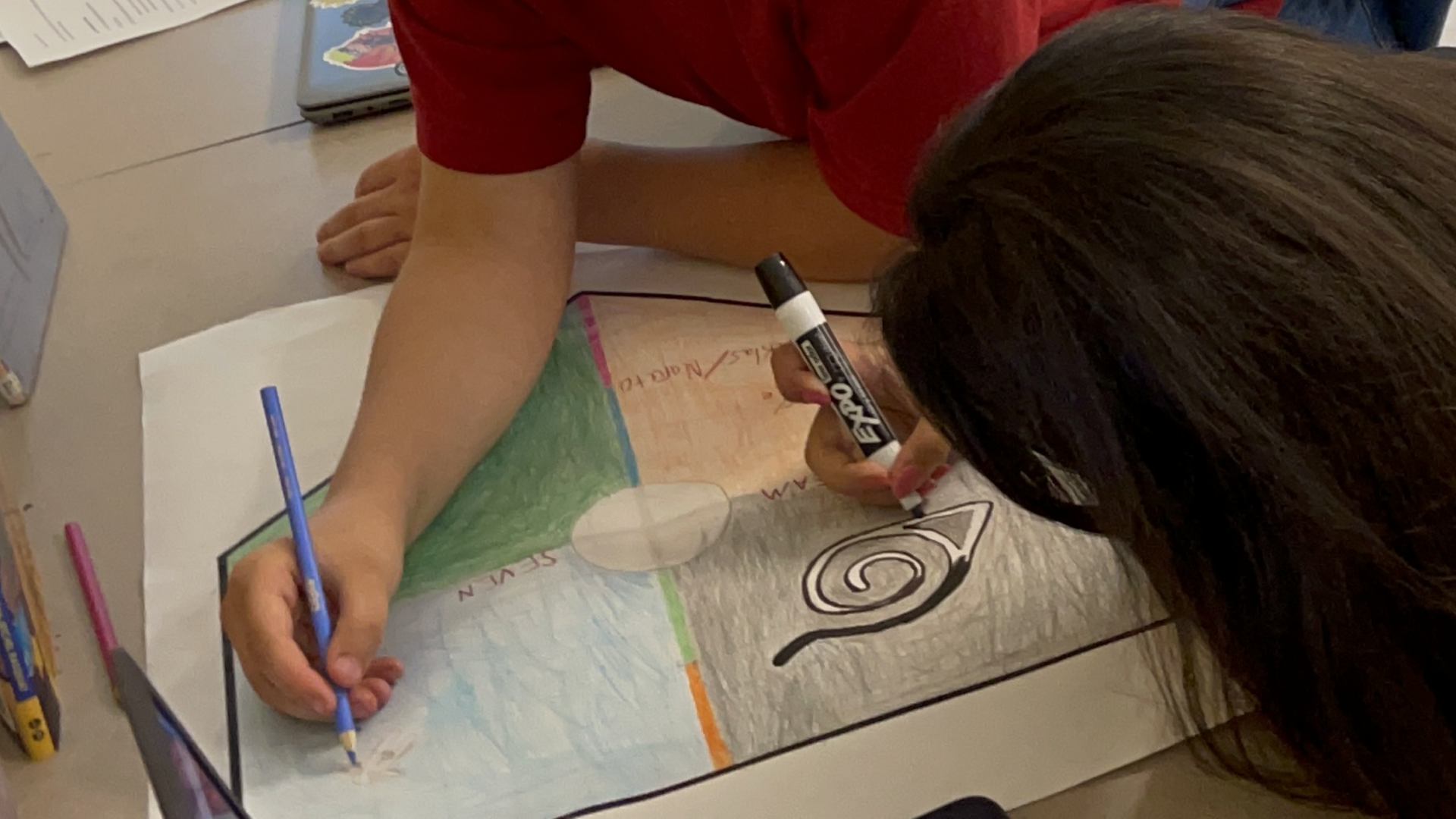
- Sessions 1–2: Students design crew badges on the coordinate plane — plotting points and connecting them. Then they use ordered pairs to locate P.I.P.E.R.'s position on a large grid map of Proxima Centauri b.
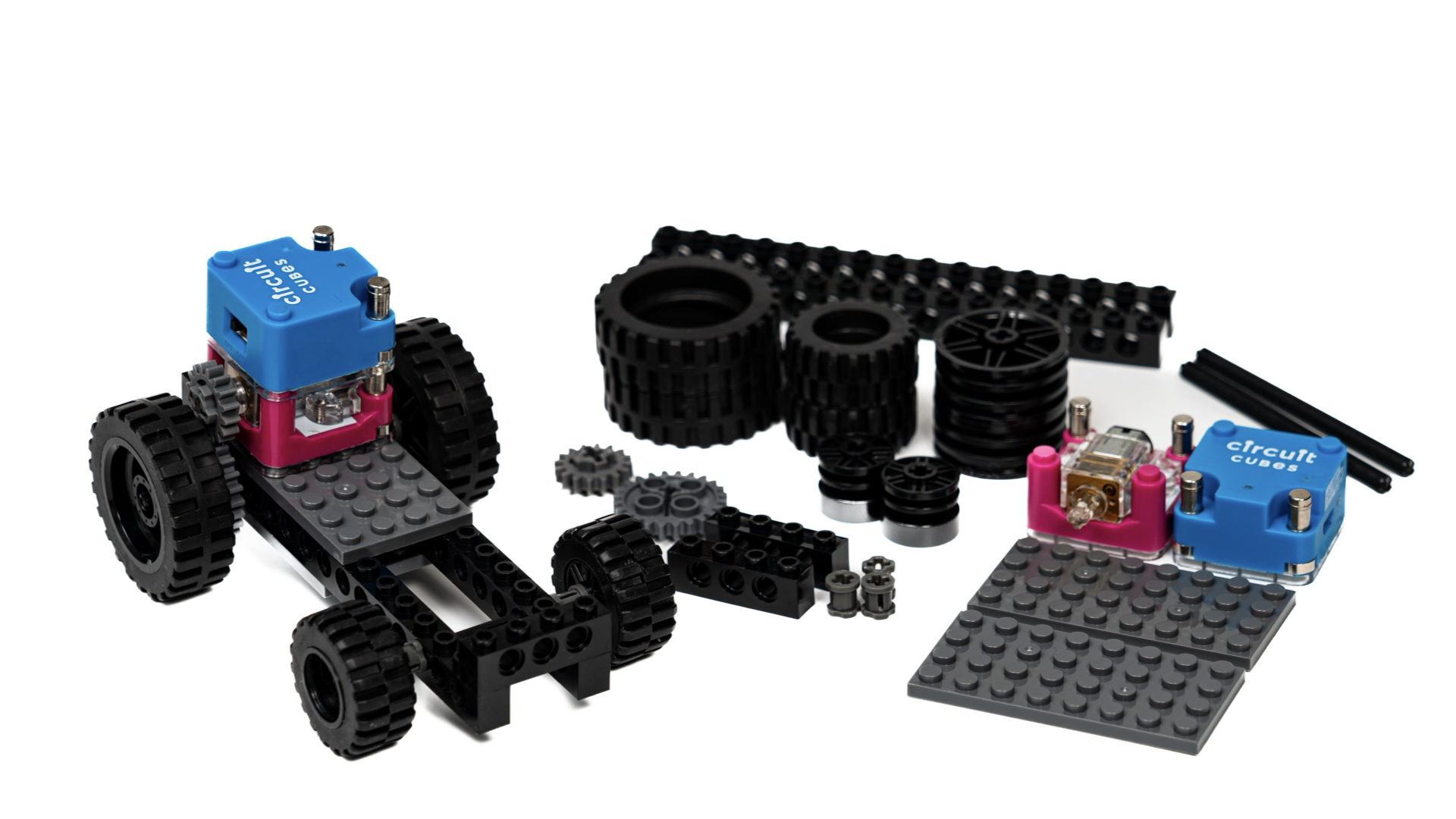
- Session 3: Engineering — students assemble their motorized E.E.V. from Circuit Cubes™ components.
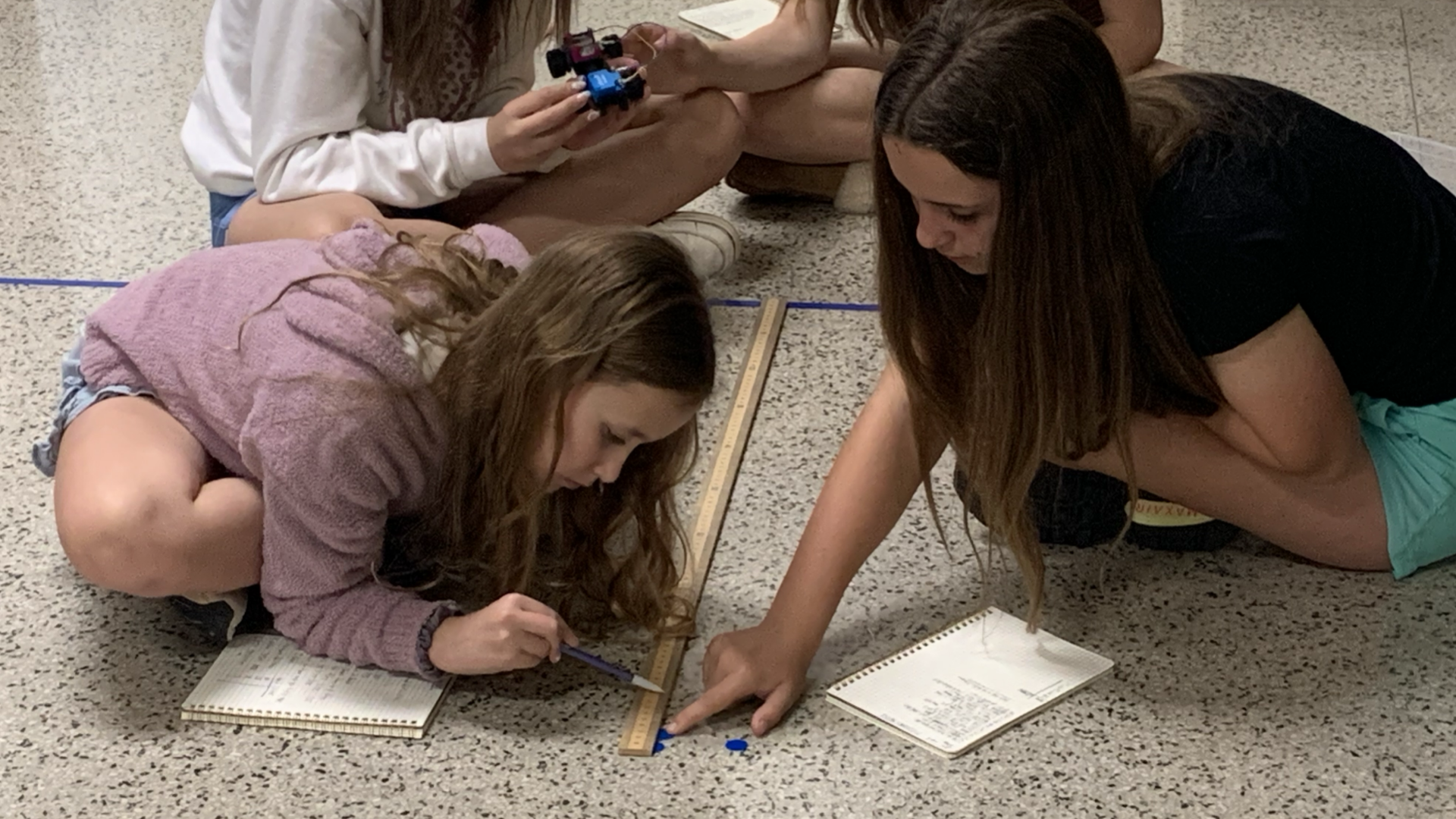
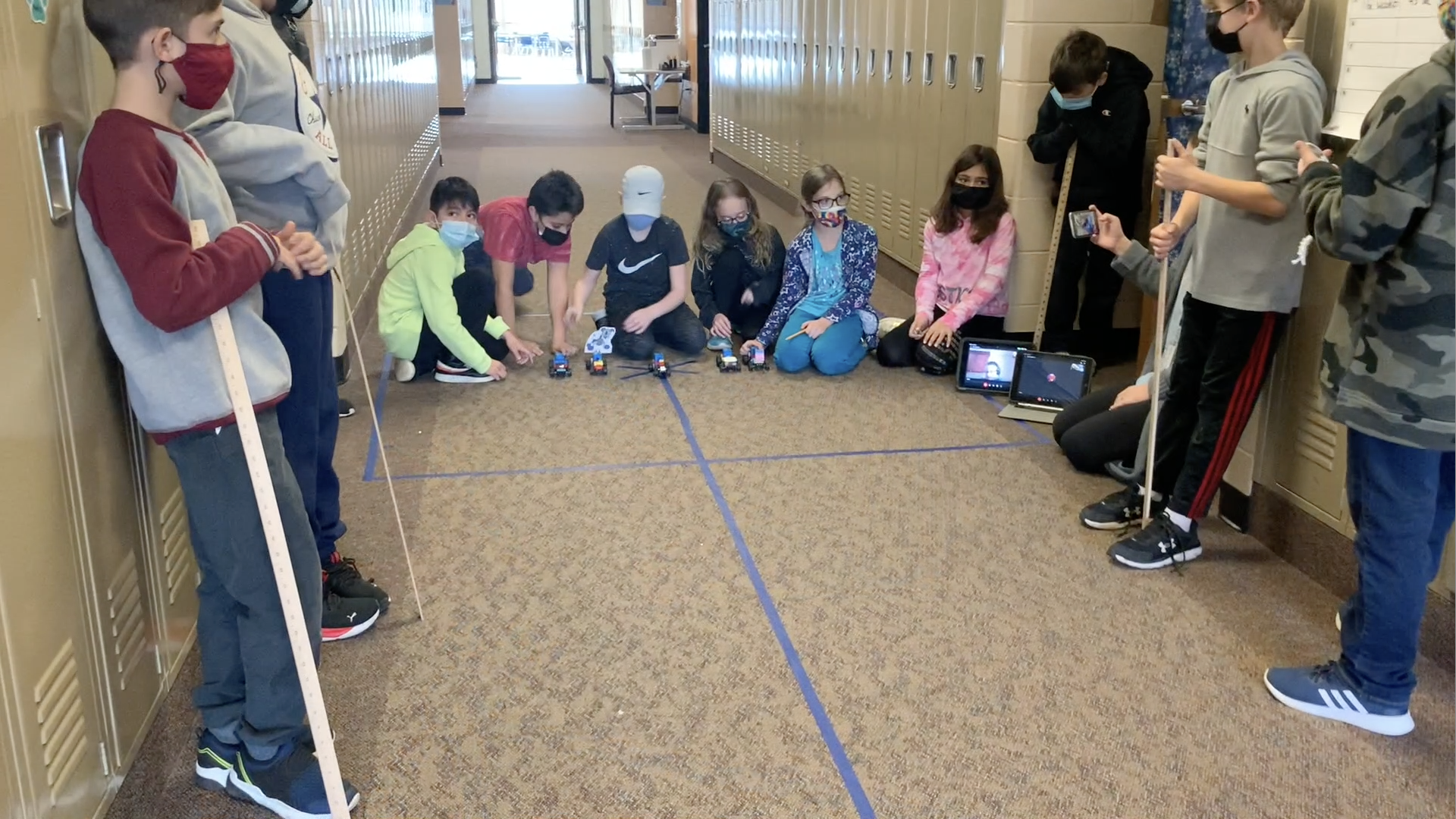
- Sessions 4–5: Students develop methods to predict the racer's rate, then collect precision data — timing runs down ramps, measuring distances, recording results in data tables.
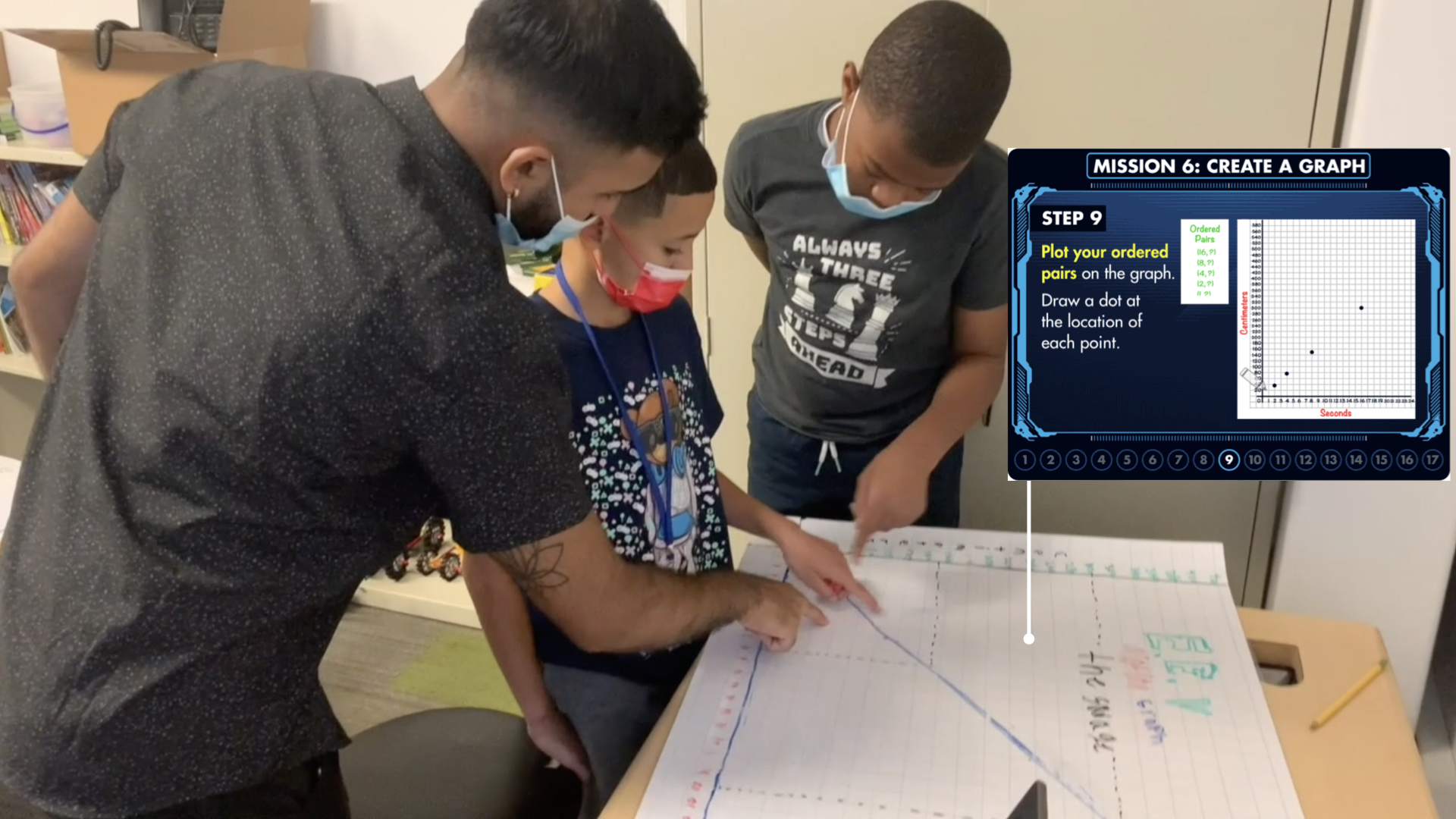
- Session 6: Students graph their data and use the graphs to predict how far the E.E.V. will travel in a given time.
- Session 7: Students simulate the rescue using place value and multiplication to calculate travel distances at scale.
- Session 8: Students decipher a security code by classifying polygons plotted on the coordinate plane — identifying shapes by their properties to unlock P.I.P.E.R.'s systems.
- Sessions 9–10: Students reactivate the robot's transmitter by interpreting graphs and tables, then plan a planetary evacuation using rate and ratio calculations to coordinate the escape.
Who It's For
- 5th grade teachers looking for hands-on supplemental curriculum in coordinate geometry and graphing
- 6th grade teachers who need review and enrichment in coordinates and data
- Afterschool and summer program directors who want structured STEM programming with built-in teaching guidance
- Curriculum coordinators looking for standards-aligned supplements that work alongside any core curriculum — no adoption process required
What's in the Kit
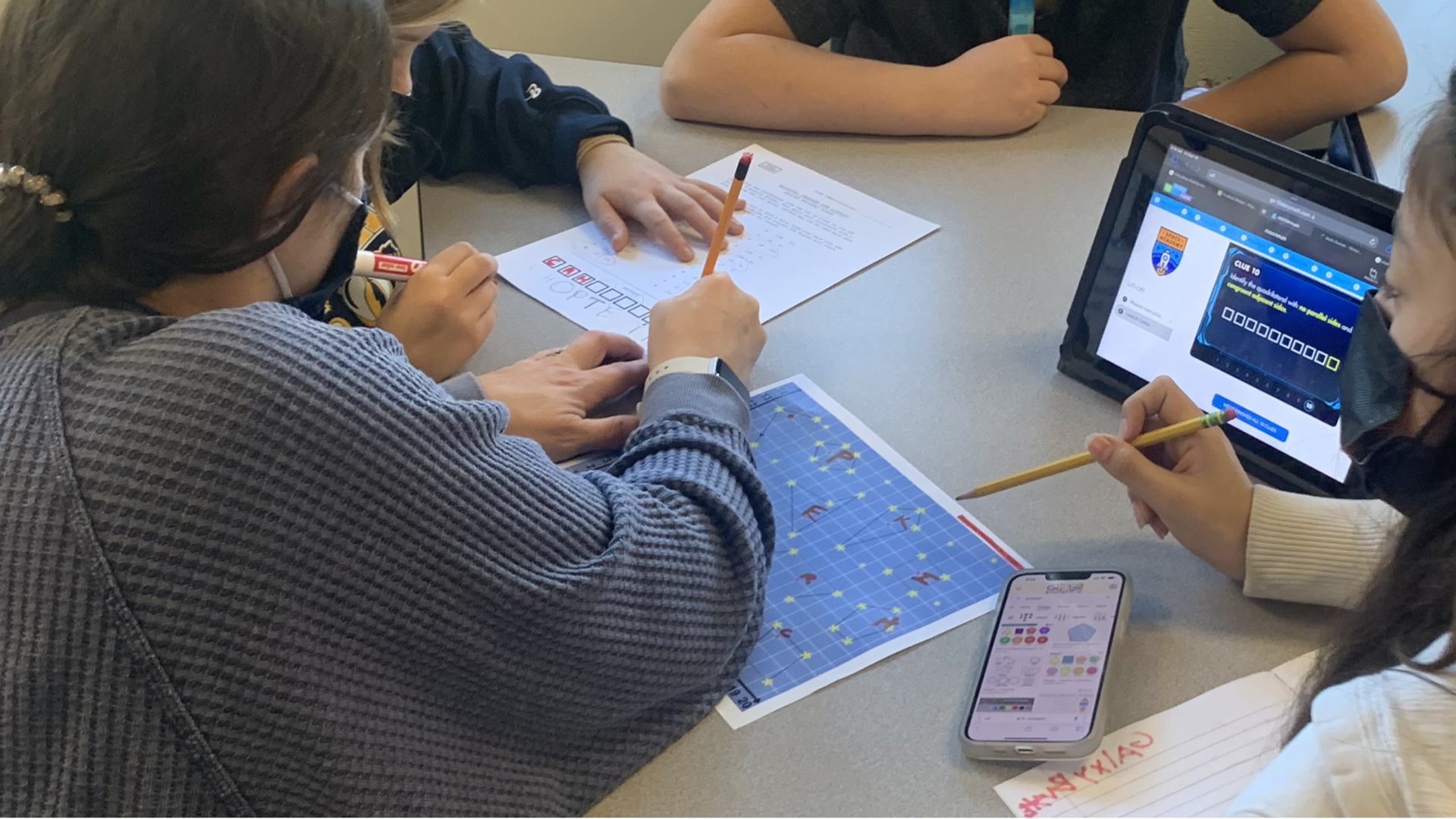
All materials are physical and fully durable — buy once, use every year. Consumable items are limited to paper-based maps and data sheets.
- Circuit Cubes™ motorized racer kits (E.E.V.)
- Ramp materials for data collection
- Tape measures and stopwatches
- Oversized planet maps and grid sheets
- Crew badge templates and coordinate plane posters
- Data recording sheets and graphing paper
- Construction paper, markers, stickers
- Quick reference booklet
10 Sessions at a Glance
Every session runs through a web-based slide portal at algebrastudio.org. Howie is the on-screen instructor in embedded video mini-lessons — he introduces each task, demonstrates the math, and guides students through the activity. The slides run the session. Open the kit, follow the slides, and go.
Sessions run between 45 and 90 minutes, with some extending longer at the teacher's discretion. The curriculum works as a daily block (3–4 weeks), a twice-weekly enrichment (5–10 weeks), or an afterschool/summer program. It supplements any core curriculum — students learn coordinate geometry and graphing through their regular instruction, and Finding P.I.P.E.R. is where they apply those concepts with physical materials and collaborative problem-solving.
Sample Lessons
Standards by Session
Finding P.I.P.E.R. covers coordinate plane, ordered pairs, graphing and patterns, and polygon classification standards in your grade 5 scope, with extensions into grade 6 ratio and rate. It doesn't replace your core instruction on these topics. It gives students a place to apply what you're already teaching, using physical materials and collaborative problem-solving.
| # | What Students Do | Standards |
|---|---|---|
| 1 | Crew badge — plot and connect points on the coordinate plane | 5.G.A.1 |
| 2 | Locate P.I.P.E.R. — ordered pairs & grid-based problem-solving | 5.G.A.1, 5.G.A.2 |
| 3 | Build an E.E.V. — engineering design | — |
| 4 | Predict rate — generate & analyze patterns | 5.OA.B.3 |
| 5 | Collect data — standardized measurement & recording | 6.RP.A.3 |
| 6 | Create graphs — plot data & make predictions | 5.OA.B.3 |
| 7 | Simulate rescue — place value & multiplication at scale | 5.NBT.A.1 |
| 8 | Decipher security code — plot vertices & classify polygons | 5.G.B.3, 5.G.B.4 |
| 9 | Reactivate transmitter — interpret graphs & tables | 5.OA.B.3 |
| 10 | Evacuate the planet — rate, ratio & graphing | 5.OA.B.3, 6.RP.A.3 |
Career & Workplace Connections
Each Finding P.I.P.E.R. session includes a one-page Workplace Connection brief that profiles a professional who uses the same math students are learning that day. Examples include:
- A drone surveyor who uses coordinate grids and GPS data to map terrain for construction and land management projects
- A logistics analyst who uses rate and distance calculations to optimize delivery routes and predict travel times
- An urban planner who uses grid maps, spatial data, and polygon classification to design neighborhoods and zone land use
These profiles connect academic content to career pathways across aerospace, logistics, urban planning, and technology.
Professional Development
It's easy to lead Finding P.I.P.E.R. — the teaching portal provides step-by-step guidance.
Professional development for Algebra Studio focuses on teaching practice — structuring hands-on learning, facilitating collaborative problem-solving. Led by a nationally recognized math educator, teachers work through a Finding P.I.P.E.R. session as learners — plotting coordinates on oversized planet maps, collecting distance and time data from motorized racers, graphing results to make predictions. Then they unpack the teaching moves with the facilitator: how to structure the teamwork, where students get stuck, what questions to ask, when to step back.
Details
- Half-day workshop, up to 30 participants
- $3,495
- Led by a nationally recognized math educator
- Teachers experience a full lab session as learners, then unpack the pedagogy
- Fundable through Title II-A professional development funds
Evaluation Partnership
Structure a rigorous study using your own assessments, your own comparison groups, and your own timeline.
Research Design Options
Option A
Simple Pre/Post
Administer a brief assessment before and after the Lab, using district benchmark questions or the Algebra Studio assessment.
Option B
Delayed-Start RCT
Half of participating classrooms begin first, the other half a few weeks later. Assess all students after the first group completes the project. Use an Algebra Studio pre/post or your own assessment.
Option C
Matched Comparison
Compare participating classrooms to non-participating classrooms with similar demographics and prior achievement.
Option D
Implementation + Perception Study
Document implementation fidelity, student engagement, and teacher perception alongside quantitative measures.
Kit
Teams are 4 students each.
Full Kit
Full-class including materials for all 7 Space Academy crews.
- 7 crew material packs
- Circuit Cubes™ E.E.V. racer kits, ramp materials
- Maps, data sheets, crew badge templates
Cost Per Student
$1,295 ÷ 28 students = $46 per student. 15–20 hours of instruction. Racer kits are durable — only paper-based materials need replacing.